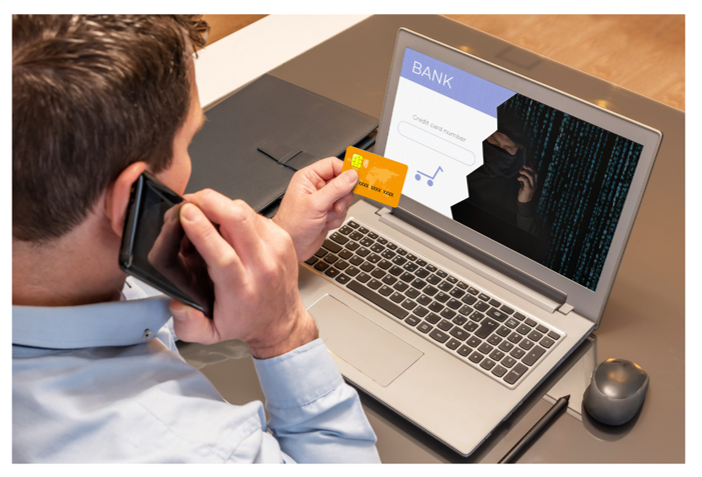
3 Simple steps to stop scammers in their tracks

Scams awareness is critical to help us rethink how we can protect our accounts, our money and our identity – and a few basic precautions can go a long way. Here are 3 simple steps to stop scammers.

First the good news. In 2023, money lost to scams was down by 13% compared to 2022 1 .

The bad news? Last year saw Australians collectively lose $2.74 billion to scams 2 .

Worryingly, these numbers could be the tip of the iceberg. Around one in three victims do not report a scam3.

That’s why the theme of Scams Awareness Week for 2024 is ‘Share a story, stop a scam’. By encouraging Australians to speak up and report scams, it is hoped that more people will know how to spot a scam 4.

This is definitely an area where there is room for improvement.

A survey by Visa found over one in two Australians believe they are knowledgeable about fraud and scams, yet one in three have fallen for at least one scam 5 .

Community First Bank has taken important steps to protect our members.

We have joined the Scam-Safe Accord, which means more checks and balances, and investments in technology, to try and stop scammers in their tracks.

Even so, consumers are, in many ways, at the frontline of scam prevention. Failing to take key precautions can leave you vulnerable to scammers, no matter how hard your bank works to protect you.

Fortunately, the converse also applies. Taking just a few simple steps can go a long way to protecting you, your money and your identity.

Here are three easy strategies worth taking on board:

1. Make passwords complex and unique

These days we are expected to remember multiple passwords for a whole variety of online accounts. Yes, it can be a chore keeping up with them all.

But please, aim for passwords that are complex and unique to each account – from online banking to your myGov account.

Let’s take a look at why this matters.

Online password management company NordPass 6 explains that hackers use computers to try to guess your password. First the computer tries 000000, then 000001, then 000002, continuing until it gets the number right. It doesn’t take long. A computer can make thousands of guesses a second.

So, it’s no surprise that it takes less than a second for hackers to crack the world’s most commonly used passwords.

For the record, the single most popular password is ‘123456’, used by over 4.5 million accounts worldwide 7 . If it’s among your passwords, change it pronto!

2. Check your account activity often

Gone are the days when we had to wait to receive paper statements to see what’s been going on in our bank accounts. These days, online banking lets us see money that’s headed into, and out of, our accounts in just a few keystrokes.

Better still, Community First’s banking app gives you real time (up to the minute) alerts about your account transactions.

This is important because the sooner you can alert us to something that doesn’t look right, the sooner we can take action.

Check your accounts regularly, and make a habit of checking your credit score several times a year. An unexpected change in your score can be an earlier warning sign that cybercrooks are using your identity to take out loans or credit cards in your name. Head to the CreditSmart website to find out your credit score – taking a look won’t alter your score in any way.

3. Think twice

The maxim ‘if it looks too good to be true it probably is’ is definitely a benchmark for consumer awareness of the risks of scams.

Advertisements on social media that promise high returns for very little risk should set the alarm bells ringing. The same applies to requests for money from someone you have only ever ‘met’ on an online dating platform.

Maintaining a healthy dose of scepticism – and disregarding the sense of urgency that scammers use to prey on their victims – can help you go a long way to avoiding becoming the next victim of a scam.

Above all, remember Community First is here to help.

If you are concerned that you may have fallen for a scam, or your accounts are in any way compromised, get in touch with us immediately.

To learn more about keeping your accounts secure, call the Community First team on 1300 13 22 77, or visit one of our Community First stores.

 1https://www.accc.gov.au/system/files/targeting-scams-report-activity-2023.pdf
 2https://www.accc.gov.au/system/files/targeting-scams-report-activity-2023.pdf
 3 https://www.accc.gov.au/system/files/targeting-scams-report-activity-2023.pdf
 4https://www.scamwatch.gov.au/research-and-resources/scams-awareness-week-2024
 5https://www.visa.com.au/about-visa/newsroom/press-releases/aussies-more-suspicious-yet-equally-likely-to-fall-for-scams.html
 6https://nordvpn.com/research-lab/payment-card-details-theft/#:~:text=These%20numbers%20are%20being%20sold,card%20numbers%20are%20being%20sold.
 7https://www.weforum.org/agenda/2024/07/popular-passwords-cybercrime-digital-safety/



No fun refunds, tax refund go on household bills

Over 9 million Australians expect a tax refund this year, with the average person anticipating a refund.

Many Aussies expect little joy from refunds, but there are ways to capitalise on your tax return

Over 9 million Australians (46%) expect a tax refund this year, with the average refund anticipated to be $1,288. That’s the good news.

Nonetheless, new research from Finder* reveals that almost 1 in 4 taxpayers plan to use their refund to pay household bills as expenses such as insurance and electricity burn bigger holes in their pockets. Yet, there are other ways to maximise your tax return. Here are five strategies worth considering.

1. Pay off debt

One sensible way to use your tax refund is to pay down any outstanding liabilities, such as credit cards, buy-now-pay-later debts, personal loans, or mortgages. While this suggestion may not be popular—only 1 in 10 (9%) Australians plan to put their refund towards paying off their mortgage as interest rates remain high, according to Finder—these debts can quickly accumulate. Making extra payments can be a positive and effective way to get ahead. Start with the debts that have the highest interest rates, usually credit cards.

2. Give your savings a top-up

If you’re unsure what to do immediately with any windfall, putting your tax refund into a savings account like the Community First Bank Goal Saver account can be an alternative option, provided you deposit at least $20 and make no withdrawals or transfers every month. We also offer a Christmas Saver account, there’s no requirement to save every month, plus there are no monthly fees. 

Another practical option is a term deposit. Since you won’t be able to access the money for a set period, this removes the temptation to spend it immediately, allowing it to earn interest while you decide how to use it. Community First offers terms ranging from 3-5 months up to three years.

3. Rev up your superannuation

While superannuation seems a little boring, another way to spend your tax refund is to top up your super fund. Not only is your superannuation taxed at the low tax rate of 15%, but you may also qualify for the government co-contribution of up to $500 per year (if you’re on a low income). Find out more information from the ATO.

4. Pay off university debts

If you’ve got a HECS-HELP debt, you can make a voluntary repayment against it. Moreover, these extra payments can be re-borrowed in the future, up to the current HELP loan limit. For more information, go to: https://www.studyassist.gov.au/help-loans/combined-help-loan-limit

5. Add value to your home

Renovating can add value to your property and make your house or apartment feel more like home. Just make sure you stick to a budget and avoid trying to do too much too quickly with limited funds. Even painting just one room can freshen things up.


*https://www.finder.com.au/news/tax-return-spending-2024

Beware of callers claiming to investigate a scam

Scammers will try anything to build your trust in an attempt to steal your money and personal information.

Latest reports tell of a scam where criminals are calling people pretending to be from the National Anti-Scam Centre. They tell you that your phone number is being used in a scam in China and offer to help you ‘clear your record’.

The National Anti-Scam Centre work to make Australia a harder target for scammers. They work together with government and industry to protect Australians by sharing resources and smarter analytics to cover blind spots, strengthen weak links and use data to react faster, stopping scams before they happen.

Spotting the scam

Scammer’s tactics are always evolving, and often they will make it look like the call is coming from a legitimate number, and this latest scam is no exception.

As always, a tell-tale sign is that the National Anti-Scam Centre will never ask for money or personal or financial information. Chances are it’s a scam, and you should hang up on unexpected callers who say they’re investigating a scam.

Recap – how the scam works

  • Someone calls you saying they’re from the National Anti-Scam Centre.
  • The phone call looks like it comes from a legitimate phone number belonging to a trusted organisation, like the government or police.
  • They say they’re investigating a phone number registered in your name that’s being used in a scam in China.
  • These criminals may tell you they work with the Chinese Anti-Scam Centre or Chinese police, and say they will help you ‘clear your record’. 4
  • They ask you questions to ‘confirm you’re not involved’ in the scam.
  • They may spend a lot of time with you, building your trust.
  • These criminals will try to threaten you to steal your money, financial and personal information.


Stay protected

STOP – Don’t give money or personal or financial information. Don’t click on any links if you’re unsure. Say no, hang up, delete.

CHECK – Scammers pretend to be from organisations you know and trust – like myGov, your bank, the police or government. You can check the call, message, or email is real by calling the official phone number of the organisation using contact details you find yourself.

REPORT – The more we talk, the less power they have. Report scams to Scamwatch. By speaking up, you protect others and stop scams before they happen. Better safe than scammed.

If you’ve been a victim of a scam

  • If you have lost money, contact your bank or financial institution immediately.
  • If you’ve had personal information stolen or need support to recover from a scam, contact IDCARE on 1800 595 160.
  • Help others by reporting scams to Scamwatch.
  • Tell your friends and family: you can share your experience, get support and help to protect others from scams.

For more information about how to avoid or report a scam, visit the Scamwatch website.

Our Green Car Loan is a winner

Community First named best car loan for EVs in Finder awards

Community First Bank has been crowned the winner of the best car loan for electric vehicles in Finder’s Car Loan Awards for 2024.

The Finder Awards looked at more than 330 car loans to find the best loan options in categories for used cars, new cars and of course, electric vehicles.

Car loans are usually the second biggest financial decision for households, after a home loan. The evolution of electric vehicles has been such that Australians are now leaning into the eco-friendly option more and more, so it’s an important awards category to have.

The thing with any loan is that you want to make sure it’s right for you. While that doesn’t always mean it’s the cheapest loan out there, the price is a good place to start.

Luckily, if you’re opting for an electric vehicle you can usually take advantage of better interest rates and fees than if you were buying a regular car. To decide the winner of this year’s best car loan for an electric vehicle, Finder compared those 2 cost factors over a 12-month period.
The interest rates stole the show for Community First’s Green Car Loan, which was the lowest amongst its competitors for that year.

In a move away from many other lenders, it even offers the same low rate whether you’re taking out a fixed rate or a variable rate.

When it comes to any loan, you need to calculate the monthly repayments plus fees – very often a monthly fee and a low rate will still work out better than a high rate with no fees.
Even taking into consideration this loan’s $295 application fee and $10 a month service fee, there was nothing taking Community First’s Green Car Loan down from the top spot.
For more information on Finder’s Personal Loans and Car Loans Awards 2024 and to see the rest of the winners, visit our awards page.

Author bio

Rebecca Pike is the senior writer for home loans at Finder. She has been writing about the mortgage market in Australia for almost 6 years and regularly appears on TV, radio and in newspapers providing commentary on Finder’s insights and research.


Credit eligibility criteria, terms and conditions, fees and charges apply. The information contained in this article is only correct at the point of time of publication. It is general information and has been prepared without taking into account your personal circumstances, objectives or needs. Please consider if this information is right for you before making a decision to acquire any product.

Our next chapter

In a step that will provide opportunities for all our members and staff, Community First Credit Union (Operating as Community First Bank) and Illawarra Credit Union are planning to merge.

In the competitive banking world, we’re always looking for opportunities to enhance the value we offer to our members. A merger with Illawarra Credit Union brings together a range of synergies and capabilities that will help position us for our next phase of growth.

The background

The Board of Directors of Community First and Illawarra Credit Union have agreed to merge, positioning both organisations for future growth.

Following the successful completion of a due diligence process, the merger of Community First and Illawarra Credit Union is now awaiting formal approval from bank regulator – the Australian Prudential Regulation Authority (APRA).

Of course, our members have a say in the merger too. Following APRA approval, a member vote on the merger will take place in late 2024 at the Annual General Meetings of Community First and Illawarra Credit Union. We will keep you up to date about where and when the AGM will take place and how you can have your say.

An exciting step forward

If all goes to plan, the merged entity will have almost 80,000 members and customers, and combined assets of approximately $2.5 billion. In a competitive banking market, this will give the merged entity valuable strength.

John Tancevski, CEO of Community First Bank, says, “The merger is an exciting step for both Community First Bank and Illawarra Credit Union. It will create valuable member benefits, allowing the two organisations to position themselves for their next phase of growth.”

A history of shared values

The fact is, Community First Bank and Illawarra Credit Union share a long history of collaboration, reflecting our shared values.

Anthony Perkiss, CEO of Illawarra Credit Union, commented, “Together we recognise the exciting synergies in combining our strengths into a single, larger community-focused financial institution where we can better meet the needs of all our members while retaining our high standards of service.”

While the merged entity would be larger than both organisations were before, we can assure members that we remain 100% committed to continuing to put you at the heart of everything we do. We pride ourselves on providing personal service and great value banking and that will never change.

In particular, the merger will see members benefit from access to enhanced technological capabilities and greater physical distribution. It also gives our resources a boost, allowing us to better meet our ongoing prudential and regulatory obligations while increasing our focus on innovation, enhanced customer experiences and growth.

Rest assured, if the merger proceeds, there will be no forced staff redundancies. So, members of both organisations will continue to be welcomed by the same friendly faces, with the same commitment to great service.

Frequently asked Questions

Community First Credit Union (Operating as Community First Bank) and Illawarra Credit Union (ICU) have shared a long history of collaborating together, reflecting our shared values. We recognise the exciting synergies in combining our strengths into a single, larger community-focused financial institution where we can better meet the needs of our members while retaining our high standards of service. The merger is a merger of equals and brings fresh perspectives to help position us for our next phase of growth. It will help strengthen our community reach through exposure to a larger member base, with opportunities to grow our deposit and capital base while creating cost and scale synergies. The two organisations will benefit from access to expanded technological capability and greater physical distribution. It also enhances resourcing capabilities which means greater ability to meet our ongoing prudential and regulatory obligations and ability to increase our focus on innovation, enhanced member experiences and growth.
Illawarra Credit Union has been in operation since 1972. The credit union has over 25,000 members and customers and $1.0Bn in funds under management. Like Community First Bank, Illawarra Credit Union is customer-owned and exists for the benefit of members. Based in the Illawarra region, the credit union distributes products and services Australia-wide, and has been recognised in numerous industry awards.
While the merged entity will be larger than both organisations were before, we can assure members that we remain 100% committed to continuing to put you at the heart of everything we do. We pride ourselves on providing personal service and great value banking and that will never change. Members of ICU will have access to Community First’s network of 12 stores across the Sydney and Greater Sydney area, providing greater convenience and support. At the same time, Community First members in the Illawarra region will have access to a store to do their banking in Wollongong, backed by local knowledge and enhanced support. The synergies created from the merger will enable ongoing investment in technology to enhance member service and security, with an expanded contact centre to better serve members. Members of both organisations can expect access to products and services they may not have access to today and more transactional banking options.
Yes – following approval from the prudential regulator, APRA, we anticipate the member voting process to occur at the 2024 AGMs of both CFB and ICU in late 2024. Further communications and notices, including key dates will be issued to members closer to the date.
CFB and ICU entered into a Memorandum of Understanding (MOU) in late 2023, with both Boards now having voted in favour of the merger proceeding following their respective due diligence processes being completed. The union is subject to a formal review and approval process firstly by our regulator – APRA (Australian Prudential Regulation Authority) and our members. Following approval from APRA, we anticipate the member voting process to occur at the 2024 AGMs of both CFB and ICU in late 2024. If approved, the merger integration process will be planned to occur in late 2024 with the system integration in the first half of 2025. Community First has a strong history in working through this process having successfully completed 6 mergers in more recent history.
Yes. Both CFB and ICU are passionate about being a mutual and existing for the benefit of members, not investors. We will continue to put our members at the centre of everything we do.
The Community First Chair, Stephen Nugent, will remain the Chair, with ICU CEO Anthony Perkiss to be appointed CEO. After 20 years in his position, Community First’s current CEO John Tancevski will assist the Board and management during the merger transition process.
The merged entity will have over 80,000 members and customers, a combined balance sheet of approximately $2.5Bn and 13 store locations stretching from the Illawarra in the south, to Penrith in the West and the Lake Macquarie region in the north. It will create a dominant community based mutual financial services organisation with combined years of operation of over 117 years.
If the merger proceeds, the Board of Directors will include representation from both CFB and ICU, with four CFB directors and three ICU directors to form the new Board.
The trading names of both entities will remain the same for at least a 12 month period. However, the banking licence will be retained in Community First Credit Union moving forward.
Importantly, there will be no forced redundancies as a result of the merger. The same friendly staff who have been serving you will continue to serve you into the future – they’ll simply be part of a larger team. Together we plan to utilise the merger as an opportunity to inject key resources where they are needed most, creating further opportunities for existing staff.

We’re here to help

Our members are an important part of the merger process and we’d like to assure you that all decisions we make are underpinned by what is in the best interests of our members.

We’ll be keeping members up to date on the progress of the potential merger via the latest news section of our website. You can also expect further direct communications from us as the process progresses.

Contact us

A bridge to your dream home

Upgrading to your next home is exciting, do you wait until your current home is sold to start house hunting.

Bridging loans – buy before you sell

Home Buying Help – Buy before you sell:

Whether you’re upsizing, downsizing or relocating, making the move to your next home can be exciting. You’ve probably built up some home equity, and for whatever reason, you’re on the lookout for the next property to call home.

The question is, do you wait until your current home is sold to start house hunting or sell first? What if you see a place you’d like to buy before your home is sold? The process can feel a little daunting.

How bridging loans work

As the name suggests, bridging loans act as a bridge that spans the funding gap between buying a new home and selling your current property.

It lets you buy a dream home even if you’re still waiting to find a buyer for your old home. That said, bridging loans are a type of home loan, and before taking on any sort of debt it’s important to weigh up the pros and cons.

The upside

It’s a short term debt. We offer up to 12 months from the date of settlement of your new property to repay your Community First Bridging Loan. This is likely to be ample time to sell your old home.

You don’t have to miss out on an ideal property. Using a bridging loan means your dream home doesn’t have to be ‘the one that got away’.

No need to make monthly repayments. Our bridging loans are interest-only, and unlike some banks, we don’t ask you to make repayments on the bridging loan during the 12 month loan term. Instead, we deduct the value of the accrued interest from the sale proceeds of your current home.

You can minimise moving costs. A bridging loan means you only have to wear the cost (and hassle) of moving once. On the other hand, if you sell before buying elsewhere, you could be up for rent on temporary accommodation, and have the added expense of moving furniture twice.

The downside

The interest rate is generally higher. However, the maximum loan term is 12 months, and most members don’t need the bridging loan for the full term. This helps to keep a lid on the interest cost. Even so, the accrued loan interest will eat into the sale proceeds of your home.

Your existing home may not sell in time, which could create stress and pressure you into taking an offer lower than you’d expected.

Bridging Loans can be complex in structure, and you need be sure the cost won’t be the make or break factor that could stop you from financing your new home. That’s why you should engage with a Mortgage Specialist; they will explain how a bridging loan works and can assist you to purchase your new home sooner.

To learn more about Community First’s Bridging Loan – and if it is the right choice for you – get in touch with us or visit your nearest Community First store. You can also head to our Bridging Loan page on our website.

Credit eligibility criteria, terms & conditions, fees & charges apply. Community First will need to hold a first registered mortgage over any properties being taken as security. Where a bridging loan is taken, all loans must be held with Community First. The maximum LVR during the peak debt is 70%.

Telephone Banking Changes

Telephone banking service will reach its end of life from 30th of November 2024.

Telephone Banking will phase out later this year

We’re writing to let you know that the software supporting our telephone banking service will reach its end of life and will no longer be supported from the 30th of November 2024. This means you will no longer be able to access Telephone Banking from this date.

Why the change?

We have accepted all extensions available to us for the continuation of this service via our third -party provider, however they are unable to extend the service beyond this date. Third party providers are no longer maintaining or developing telephone banking software as the number of users has rapidly declined over recent years. Community First has sought other platforms and we have not been able to find an alternative and compatible vendor.

We’re not alone…

Customers of other financial institutions using the same service will also be impacted by this change. We understand that it will take some time to adjust to this change however we want to assure you that there remain a number of options to help you manage your banking.

Telephone banking methods have changed

The world has changed considerably since telephone banking was first introduced. Originally, telephone banking was rolled out to offer customers a branchless banking option, by allowing customers to perform simple functions such as retrieve a recent transaction or account balance.

Convenience of Mobile Banking

As mobile banking and banking apps became the norm, they offered a far richer experience allowing customers to do more than they ever could without visiting a branch. Please note that a mobile number is mandatory to enjoy full access to Internet and mobile banking.

Enhanced Banking Experiences

Over the last decade, we’ve been investing in continued enhancements of our mobile app and internet banking services, providing members with enhanced security measures, more self-serve options to help you save time, stronger passwords and greater overall convenience.

Other ways to bank

Internet Banking and Mobile Banking offer a safe and secure way to manage your money. Please note that a mobile number is mandatory for full use of these services. In addition, the following ways to bank can also help you manage your banking.

Over the phone and in-store: Our staff can help with enquiries and transactions on your accounts both over the phone or at a store near you.

Alerts: Set up and manage a range of free SMS and email alerts via internet banking, such as your end of day account balance or when money comes in or out of your account.

Bank@Post: Make cash withdrawals, cash deposits or cheque deposits at Australia Post outlets with the Bank@Post symbol.

ATMs: Access thousands of ATMs Australia wide to withdraw cash, make transfers and check your balance.

We’re happy to help

If you need a hand with other ways to bank or have any questions about this change, please feel free to reach out to our friendly staff so we can talk you through your options on 1300 13 22 77.

Gambling transactions now blocked on credit cards

From 18 April 2024, changes will be applied to credit cards

 
With the introduction of the Interactive Gambling Amendment (Credit and Other Measures) Bill 2023 by the Federal Government, credit cards, amongst other payment methods, can no longer be used as a way to pay for interactive wagering services.

The Bill aims to prevent gamblers from spending money from a credit facility that they may not have the means to repay. The Bill also aims to bring online gambling inline with other forms of gambling for which credit cards also can’t be used.

More details on the bill can be found at the Australian Parliament House website.

What’s changing?

The use of credit cards to pay for gambling services is on the rise and can cause significant financial stress for individuals and their families.

From 18 April 2024, changes will be applied to Community First credit cards to block them from being used as a payment method for online gambling services. The block relies on information provided by those organisations classified under certain online (and other) gambling-related merchant category codes. Any transactions identified from these operators will automatically decline.

Community First joins other financial institutions who have already put similar blocks in place for their credit products.

Alternative option

When it comes to spending your own money on gambling services, you have a choice. Customers can still use a debit card which is linked to a transaction account holding the individual’s own money.

We’re here to help

If you have any questions or would like more information about these changes, give us a call on 1300 13 22 77, email us at askus@communityfirst.com.au or visit your local financial services store.

If you or someone you know is problem gambling and needs extra support, consider the following services:

• Gambling help online – Get free 24/7 support for anyone affected by gambling by calling 1800 858 858 or visit www.gamblinghelponline.org.au.

• Bet Stop – A free Australian Government initiative to block yourself from all licensed Australian online gambling providers. Visit www.betstop.gov.au.


Last updated: 19 April 2024

The information contained in this article is only correct at the point of time of publication. It is general information and has been prepared without taking into account your personal circumstances, objectives or needs. Please consider if this information is right for you before making a decision to acquire any product.

Fraudulent website mirrors AUSTRAC

A fraudulent website has been created by scammers to mirror some of the content on the AUSTRAC website.

Message from AUSTRAC

We have identified a fake AUSTRAC website. This fraudulent website mirrors some of the content on the AUSTRAC website and uses the URL “https://austracs.com”. We believe this website has been established for the purposes of committing fraud.

Scammers will often attempt to trick you into giving out your personal or business information or to persuade you to make payments or transfer funds. To achieve this, scammers often pretend to be from trusted organisations like AUSTRAC and will seek to appear credible by using a fake website or emails with the AUSTRAC logo and branding.

Signs of a scam

There are certain things AUSTRAC will never do. You should be suspicious of a call or email that:

• asks you to provide your business details via a website form outside of the AUSTRAC Online portal
• asks you to pay penalty fees by money transfer
• asks you to pay a fee or tax to authorise release of funds to your bank account
• threatens you with arrest if you don’t pay a penalty
• asks you for documentation regarding imported goods
• tells you we have intercepted your package at the border
• tells you we are freezing accounts or transactions
• says you can avoid prosecution by paying penalties.

If the phone call or email does any of these things, you can be sure it hasn’t come from us.

What to do if you receive a scam communication

If you think a call, email or message claiming to be from us is not genuine, do not engage with the scammer. Report the incident to Scamwatch.

Do not:

• phone them back
• reply to the email
• click any links
• download any files.

Report it

• Report the incident to Scamwatch or your local police.
• For online or email scams, contact Report | Cyber.gov.au.

More information

If you have concerns about identity theft, contact IDCARE.

To find out more about AUSTRAC, visit our What we do page.

How to keep your home cosy without overheated power bills

As winter approaches and energy costs continue to soar, keeping your home warm without breaking the bank.

How to keep your home cosy without overheated power bills

As winter approaches and energy costs continue to soar, keeping your home warm without breaking the bank becomes a priority for many households.

With electricity prices spiking in recent years, it’s understandable that families are seeking solutions to maintain a comfortable living environment at home without incurring exorbitant bills.

Fortunately, you can implement several affordable and immediate strategies to keep your home warm and cosy as the mercury drops while being mindful of your energy consumption and expenditure.

1. Optimal temperature management

Start by setting your thermostat to an efficient temperature range. According to energy.gov.au, maintaining a room temperature between 18 and 21 degrees Celsius is ideal for comfort and energy savings² . However, individual preferences vary, you may prefer a slightly warmer temperature to remain warm during those winter months. Remember, every degree you increase your heating can add up to 10% to your energy use, so adjusting your thermostat gently can make a noticeable difference.   

2. Layer up instead of cranking up the heat

Rather than relying solely on heating appliances, consider wearing an extra layer of clothing indoors. A pair of socks or slippers and a snug jumper can provide additional warmth, allowing you to keep the heaters or air conditioners at a lower setting without sacrificing comfort.

3. Open windows can cost

Up to 40% of a property’s heat can escape through its windows. Enhancing your home’s insulation with high-quality curtains and blinds can yield remarkable improvements in warmth retention at night. Opt for fabrics renowned for insulating properties, or choose curtains equipped with thermal lining.

Also, installing fitted pelmets (curtain boxes) above curtains is another effective method to minimise heat loss.

4. Maximise natural light and minimise draughts

Curtains play a crucial role during the winter season. Opening the drapes during the day allows sunlight to enter and naturally heat the space but remember to close them at night to retain warmth. Furthermore, it’s essential to seal any drafts around windows and doors to prevent heat loss and maximise the efficiency of your natural heating system.

5. Strategic room usage

Encourage family members to spend time together in common areas, such as the living room, rather than heating individual rooms. This practice helps minimise the need for multiple heating sources, resulting in significant energy savings over time. Ensure rugs placed on cooler surfaces such as tiles to help the room feel cosier.

6. Install a water-efficient showerhead

Heating water contributes significantly to energy expenses. Installing a water-efficient showerhead stands out as one of the most budget-friendly methods for reducing water consumption. What’s even better is that you don’t need to be particularly skilled with the tools to install them.

7. Consider alternative heating sources

Wood is a renewable and potentially cost-effective fuel source for heating homes. However, using sustainably sourced wood and operating airtight, slow-combustion heaters are essential for optimal efficiency and minimal environmental impact. Exercise caution when using fireplaces to prevent air pollution and ensure safety. Although high energy bills can significantly impact our living costs, there are genuinely budget-friendly strategies available to maintain a warm and cosy home this winter without adding extra pressure to the family budget.